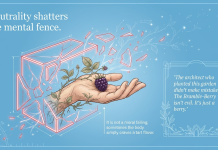
The Tale of the Restricted Garden
Imagine a vast, lush village where everyone lives inside a beautiful valley. At the center of this valley is a massive, wild garden created by the village’s original architect. The garden contains every fruit, flower, herb, and spice imaginable.
When the village was first built, the architect said, “I have made all of this for you. Explore it, taste it, and learn from it. It is all yours.”
However, over generations, the villagers started drawing lines. They built fences inside the garden. They labeled the sweet, common apples as “Pure and Spiritual.” But in the back of the garden grew a deep purple, tart berry called the Bramble-Berry. The village elders decided the Bramble-Berry was “lowly, corrupting, and sinful.” They told everyone that looking at it would lower their standing in the village.
The Cycle of the Forbidden Berry
A young villager named Leo grew up hearing these rules. One day, walking past the fence, he smelled the rich, complex aroma of the Bramble-Berry. He felt a deep desire to taste it.
But immediately, a voice in his head—the voice of his society—said, “You are a bad person for wanting that. Spiritual people only eat apples.”
Because Leo judged his own desire, he began to feel heavy, guilty, and ashamed. His emotional state plummeted. He felt isolated and “low.” And a strange thing happens when we feel low and starved of joy: we desperately crave comfort.
Because he already felt like a “bad, low-vibration” person, the invisible barrier was broken. He thought, “I’m already ruined for wanting it, so I might as well eat it.” He crept over the fence, snatched a handful of Bramble-Berries, and stuffed them into his mouth. But he didn’t even taste them. He swallowed them quickly, filled with panic, looking over his shoulder, judging himself the entire time.
Because the experience was filled with shame and rush, his desire wasn’t actually satisfied. The guilt kept him in that heavy state, and within days, the intense, compulsive craving for the forbidden berry returned. He was trapped in a loop: Desire -> Self-Judgment -> Emotional Drop -> Compulsive Indulgence -> More Judgment.
The Shift to Neutrality
One day, an old traveler arrived from a distant land. She saw Leo standing by the fence, staring at the berries, looking miserable and conflicted.
Leo confessed his secret shame to her. The traveler laughed softly. “Leo,” she said, “The architect who planted this garden didn’t make mistakes. The Bramble-Berry isn’t evil. It’s just a berry. It has a tart flavor, and sometimes your body craves tartness. The only thing making you sick is the fence you built in your mind.”
She pointed to the elders nearby, who were wearing heavy, rigid woolen robes, arguing about which fruits were holy. “See their beliefs? Those robes look terribly uncomfortable in this summer heat. Beliefs are just clothes. They are wearing heavy wool because they think they have to. You don’t have to wear their clothes.”
The Pure Experience
Leo took a deep breath. He let go of the village elders’ opinions. He realized that somewhere in the world, someone would disapprove of any fruit he chose to eat. He decided he didn’t need their permission anymore.
He walked over to the Bramble-Berry bush, but this time, his vibration didn’t drop. He didn’t feel like a criminal; he felt like an explorer. He picked one single berry. He sat down in the grass, completely at peace, and ate it slowly.
It was tart, rich, and grounding. Because he had a pure experience without a single drop of guilt, his desire was completely satisfied. He didn’t feel a compulsive need to gorge himself, nor did he feel the urge to sneak back the next day. He wiped his hands, smiled, and walked away. He was free to eat an apple tomorrow, or nothing at all, choosing purely based on how he felt in the moment.